
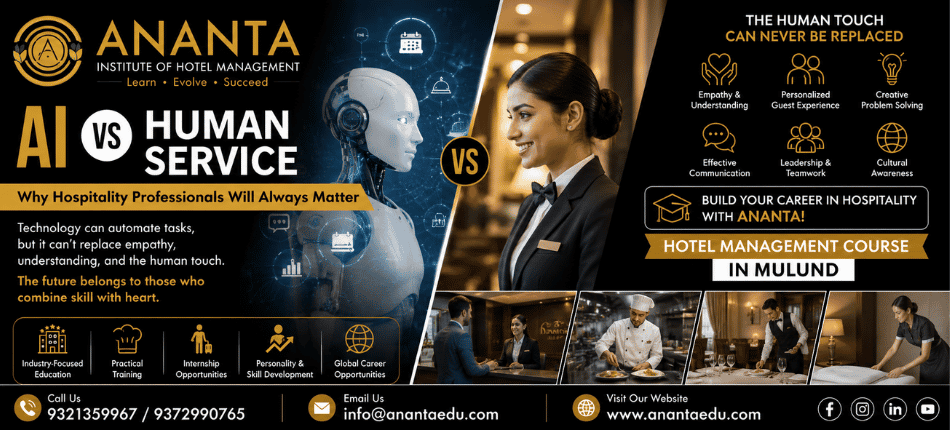
AI vs Human Service: Why Hospitality Professionals Will Always Matter |Hotel Management Course in Mulund – Ananta Institute of Hotel Management
Artificial Intelligence (AI) is transforming industries around the world, and hospitality is no exception. From AI-powered chatbots and self-check-in kiosks to automated room service and smart hotel management systems, technology is making hotel operations faster and more efficient. While these innovations improve convenience and productivity, they cannot replace the warmth, empathy, creativity, and personal connection that skilled hospitality professionals provide. Hospitality is built on creating memorable guest experiences, and genuine human interaction remains at the heart of exceptional service.
Discover why hospitality professionals remain irreplaceable despite AI advancements and how a Hotel Management Course in Mulund prepares you for future careers.
What Is AI in Hospitality?
Artificial Intelligence in hospitality refers to the use of intelligent technologies that automate routine tasks and improve operational efficiency. AI is used for online booking systems, virtual assistants, personalized guest recommendations, automated customer support, revenue management, facial recognition, housekeeping scheduling, and predictive analytics. These technologies help businesses save time, reduce operational costs, and improve decision-making. However, AI works best as a support tool rather than a replacement for hospitality professionals who handle complex guest interactions and emotional situations.
How AI Is Transforming the Hospitality Industry
The hospitality industry has embraced AI to enhance efficiency and improve the guest experience. Hotels now use AI-powered chatbots to answer customer queries, smart room controls for personalized comfort, automated check-in and check-out systems to reduce waiting times, and data analytics to understand guest preferences. Restaurants use AI for inventory management and reservation systems, while airlines and cruise companies rely on AI for customer support and operational planning. These innovations allow businesses to streamline operations, but the human touch remains essential for delivering personalized service and building lasting relationships with guests.
AI vs Human Service: What’s the Difference?
Although AI excels at processing data, automating repetitive tasks, and providing quick responses, it lacks emotional intelligence, empathy, creativity, and cultural understanding. Human hospitality professionals can interpret guest emotions, handle unexpected situations, resolve complaints with compassion, and create memorable experiences through personalized interactions. While AI follows programmed instructions, humans can adapt to unique situations, communicate effectively, and make thoughtful decisions. This balance between technology and human service is what defines the future of the hospitality industry.
Why Hospitality Professionals Will Always Matter
Hospitality is fundamentally a people-centered industry where exceptional service goes beyond efficiency. Guests value warm greetings, genuine conversations, personalized recommendations, and staff who understand their individual needs. During emergencies, special requests, cultural differences, or emotional situations, human professionals provide reassurance and flexible solutions that AI cannot replicate. The ability to create trust, build relationships, and deliver unforgettable experiences ensures that trained hospitality professionals will always remain indispensable, regardless of technological advancements.
Hospitality Skills That AI Cannot Replace
Several essential hospitality skills require human judgment and emotional intelligence.
These include:
- Empathy and emotional understanding
- Effective communication
- Problem-solving
- Conflict resolution
- Leadership
- Teamwork
- Cultural sensitivity
- Creativity
- Personalized customer service
- Decision-making under pressure
These soft skills continue to be highly valued by employers worldwide.
How AI Supports Hospitality Professionals
Rather than replacing employees, AI enables hospitality professionals to focus on delivering better guest experiences. By automating repetitive tasks such as booking confirmations, billing, room allocation, and inventory management, AI allows staff to spend more time interacting with guests and solving complex issues. Technology also provides valuable insights into customer preferences, enabling professionals to deliver more personalized services. This collaboration between AI and human expertise creates a more efficient and guest-focused hospitality environment.
Career Opportunities in the AI-Driven Hospitality Industry
The integration of AI is creating new career opportunities for hospitality graduates. In addition to traditional roles such as Hotel Manager, Front Office Executive, Food and Beverage Manager, and Guest Relations Executive, professionals can now pursue careers in hospitality technology, revenue management, digital guest experience, hotel operations analytics, customer experience management, and hospitality software implementation. Graduates who combine hospitality knowledge with digital skills will have a competitive advantage in the evolving job market.
How Students Can Prepare for the Future
Students should focus on developing both technical knowledge and interpersonal skills to succeed in the future hospitality industry. Learning about AI tools, hotel management software, digital communication, and data analytics can improve career prospects, while strong communication, leadership, adaptability, teamwork, and customer service skills remain essential. Practical training, internships, language proficiency, and continuous learning will help students stay relevant in an industry where technology and human expertise work together.
Why Choose Ananta Institute of Hotel Management?
Ananta Institute of Hotel Management provides industry-focused education designed to prepare students for the modern hospitality sector. The institute combines practical training, experienced faculty, internship opportunities, personality development, communication skills, and industry exposure to help students build successful careers. Students gain hands-on experience in hotel operations while learning about emerging technologies that are shaping the hospitality industry. With a strong emphasis on professional excellence and customer service, Ananta equips graduates with the knowledge and confidence to succeed in hotels, airlines, cruise lines, luxury resorts, and international hospitality organizations.
Conclusion
Artificial Intelligence is transforming the hospitality industry, but it cannot replace the human qualities that define exceptional guest experiences. Empathy, communication, creativity, and personalized service remain the foundation of successful hospitality careers. The future of hospitality lies in combining advanced technology with skilled professionals who can deliver meaningful human interactions. By pursuing a Hotel Management Course in Mulund, students can develop both technical expertise and people skills, ensuring they remain valuable in an increasingly technology-driven hospitality industry.
Hotel Management Course in Mulund Hotel Management Course in Mulund Hotel Management Course in Mulund Hotel Management Course in Mulund Hotel Management Course in Mulund Hotel Management Course in Mulund Hotel Management Course in Mulund Hotel Management Course in Mulund